Fanfictionalization and the Downfall of Hollywood Romance
In recent years, there has been a rather influx of fan works making their way into the mainstream. These novels, movies, and TV shows, which have their origins in fanfiction and the fanfiction community, are then bought up by big publishers, where the author changes the names and a few character traits to protect against copyright infringement and throws them out into the world.
These novels often sell particularly well, and this concept isn’t necessarily new. Many of my favorite teen romance series, such as Twilight and The Mortal Instruments, are the result of this process. This is not to say that fanworks and their authors don’t have a place in the publishing industry, or in Hollywood. I am a firm believer in the symbiotic relationship of fan culture, pop culture, and the arts as an industry. One does not survive without the other, and this is the reason why Anne Rice’s Interview with a Vampire fell so spectacularly out of social consciousness for so many years (until recently) after her rage and infamous copyright attacks against fanfiction authors. There’s a healthy balance of allowing some derivative work that cultivates a community around your IP, but not allowing them to overtake it.
However, what I have noticed in recent years is not only the substantial increase in the volume of re-worked fanfiction making its way onto bookstore shelves, but also an increase in the popularity of the “fanwork style media” in general. Works like Fourth Wing, and the Court of Thorns and Roses, the Bridgerton books, etc., are becoming increasingly popular, sensationalized, even. Now, a comparison could be made that these books lean more heavily into the standard trash romance tropes, found in the books you used to see for $1 near the grocery store checkout and in bargain bins. This might be more true than even the argument I am about to make, and I am certainly no expert in romance novels, but I would consider myself an expert in fan fiction.
I have been active as both a writer and a reader of fanfiction for over 10 years, have written and read numerous academic papers on the relationship among Japanese BL, Chinese Danmei, and Fanfiction in creating queer spaces, and have immersed myself in copyright law to protect fan communities. There is substantial crossover between the romance genre and fanfiction. Both are devalued as “worthless” reading material, tossed aside under the assumption that they’re all ‘spice’ and no substance. This is not always true of either group, but it is true of what has largely become of the books, films, and television that are saturating our space now.
Fanfictionalizing Wuthering Heights
The reason I chose to write this article in the first place, how the thought even occurred to me, was that I was watching a beautiful comparison between the original content of Wuthering Heights, Emily Brontë’s classic gothic novel, and Emerald Fennel’s new film interpretation. (watch the video here). I have a somewhat petty dislike of Emerald Fennel, I won’t deny; however, nothing concrete or strong enough that it would have dissuaded me entirely from seeing this film. I do love movies after all. I would also like to note that I am not a big fan of the book Wuthering Heights. I read it, much like Fennel, when I was 14 and didn’t really find it enjoyable. Were I to read it again, my opinion might change, but I want it clear that my hatred for this film does not stem from frustration at an inaccurate interpretation of the novel. As I am a supporter of fanfiction, I think it’s fairly clear that I am always an advocate for interpretation. I actually tend to prefer things where it is not a direct line-for-line replication of its source material. So what has this film done, even before its release, to capture my ire so greatly? It is relying on the tropes, culture, and theming, largely associated with fanfiction and romance novels, to sell itself and devalue not only the source material but the genre of romance as a whole.
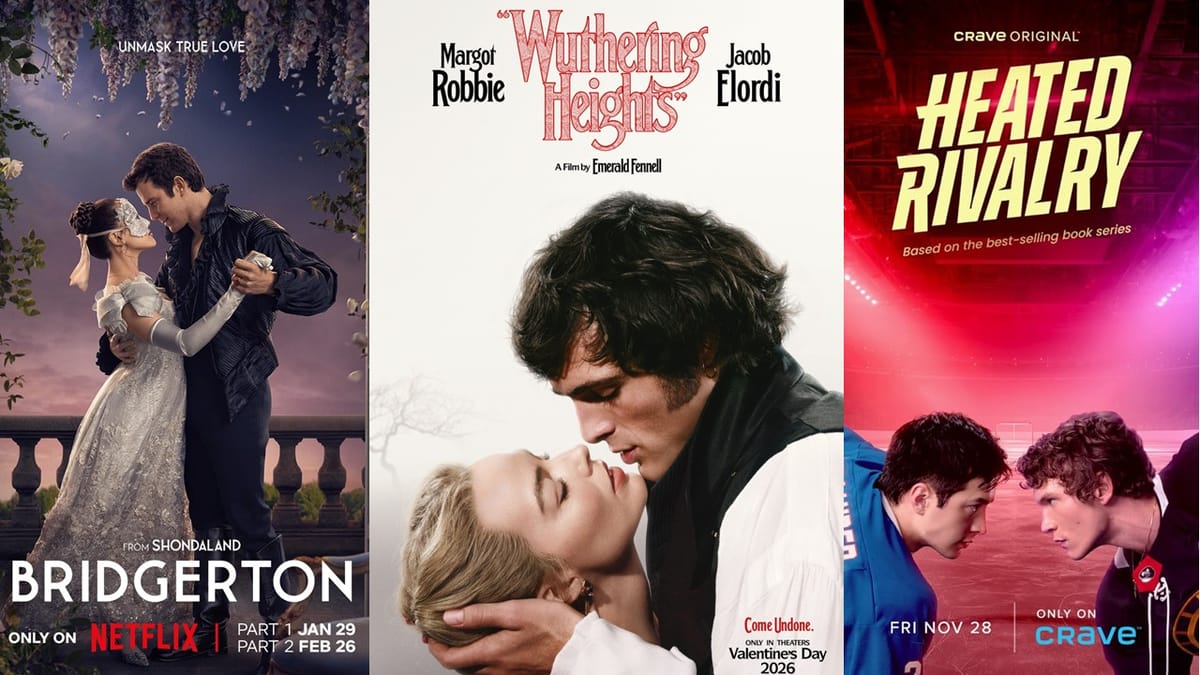
With the rise in popularity of “trash” romance, of romance tropes, of period pieces and romantacy, we are now surrounded with things like Bridgerton, Heated Rivalry, Kissing Booth, Red, White, and Royal Blue, and numerous others, the list goes on, so far I cannot name them all. Many of these are not high quality; the writing is weak, the characters are flat, the entire intrigue of the story lies in the intensity of their longing stares, and, more often than not, a poorly shot, steamy scene that usually lasts too long to be really enjoyable. The sex in most instances does little to progress the story, and does not contribute to the characters; it is gratuitous while simultaneously feeling awkward. When did softcore porn become such a foundational part of our idea of romance? Where is the emotional intimacy? Can filmmakers and authors no longer write and create compelling romance that doesn’t hinge on how spicy things get after their lips make contact?
This is not to say nudity and sexuality and sex scenes do not have a place in cinema, novels, or TV. Sex is a powerful tool, and should be used as such; sometimes having a beautiful actor without their shirt on isn’t without its own appeal either. Hot people are a draw, and actors are the beautiful people of the world. Challengers, Call Me By Your Name, Carnival Row, and even Saltburn, despite my distaste for it, are examples of sex as a tool of the story. There are plenty of non-romantic examples of sex as an effective storytelling tool as well. Black Sails, Game of Thrones, Westworld, and Rome are just a few of the television titles that come to mind as I am writing this; there are invariably many more.
The failure of Emerald Fennell's film before it even hits the theaters is, at its core, its relationship to Wuthering Heights at all. Wuthering Heights is not really a romance novel, even my bored, uninspired 14-year-old mind knew that. It is a story about class struggles, aristocratic violence, and complicated families. It’s bordering on incestuous and is aggressively violent. The most common theme is cruelty. Why would you package it as a steamy, vapid romance?
If one were to make a romance film out of the relationship between Catherine and Heathcliff, I imagine that it would need to lie more in the complexity of human relationships, the codes in which they speak, and the quiet ways in which they bypass the social restrictions and expectations placed upon them. There would be very little spice, and the writing and story would rely on the blurring lines between love and hate and how those patterns are acted out within people’s lives. From interviews, reviews, and trailers, this doesn’t seem to be what’s happening, and it’s certainly not how it is being marketed.
To say probably the most slanderous thing I will say this whole article, it seems to me that Emerald Fennel did not, in fact, read Wuthering Heights at 14 and instead read Eclipse (the Twilight book) and gleaned from it a Bella/Edward style interpretation of Catherine and Heathcliff, as that is far more in line with the film she seems to be creating.
The marketing of the film hinges on the public’s obsession with the spicy romance genre, with the popularization of fanfiction culture and overt sexuality. Even the costumes reflect a hypersexualized, but avant-garde Bridgerton-style “period adjacent” nightmare meant to draw in those looking for a “modernized” interpretation of something set in a time of racism, misogyny, violent classism, and suffocatingly rigid social rules and structures. They do not yearn for the period piece, but rather an airy, vague connection to it, and for something that has less substance than plain bread. So that is what Fennel has created with “Wuthering Heights,” and of course, fans of Brontë, fans of period pieces, and well, people who exist on the internet who aren’t racist and expected to see Heathcliff as a dark-skinned man, are rightfully upset. Had she simply made a silly period romance movie and not connected it to Wuthering Heights, I imagine the internet would have devoured it without question.
Where is the Love? Is Sex All That’s Left?
The greater concern for me with this film lies in the fact that critics and audiences alike are willing to bypass this quiet death of not only the period piece and well-intentioned adaptations of classic literature, but also of the romance genre and love stories as a whole. I will never be caught disputing the value of “trash” media; as it were, we cannot only subsist on things of “quality” and having easy-to-consume, joyful media is essential to a joyful life. Society at large seems to agree with me, as I have just proven by listing the numerous titles through which fanfiction and romance have sold themselves to people. They are a genre of their own. They are associated with steamy (if bad) sex scenes and longing glances with little to no quality dialogue. Trash at its finest, and that is fine, they have their place, I hope they continue to thrive.
Unfortunately, though, I fear we are losing the true cinematic Hollywood romance, that it is slowly and quietly being replaced by a shallow, hypersexualized nothing-burger, packaged as a 3-course dinner. I fear the day that we will have no more truly romantic films, hinging on emotional connection rather than sex, and social intimacy, not just physical attraction, and that the day this disappears, we will have no more great love stories.