Iron Lung Movie Review and Response
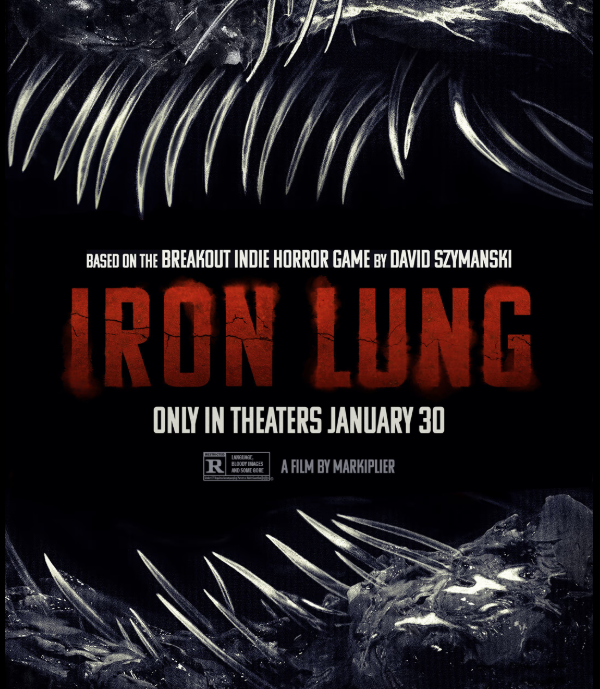
I just got back from my second viewing of Markiplier's Iron Lung, which, on its second watch, still stands as one of my favorite horror movies of all time. Now I am no horror movie critic, and I can probably count on both hands the number of horror movies I have seen in my life, so I can't even say I am cultured in the horror movie genre, but regardless, I'd like to give a full overview of my thoughts, from summary to critical response to the success of the film. Strap in, this is a long one.
Summary
In case you haven't seen it or haven't heard about it through all the online buzz, the movie follows a convict who is welded into a makeshift submarine and tasked with traversing and documenting a blood ocean on a distant moon. The universe seems to be coming to an end: all the stars have gone out, and the planets have disappeared; very little remains of humanity. The convict is sent down with very little chance of return, and a fleeting hope for freedom and the further hope that the salvation of humanity lies somewhere in the depths.
Plot, Universe, and Lore
Here is where the review becomes riddled with spoilers, so if you haven't seen the movie and don't want it ruined, turn back.
The movie's plot is original; it leans more toward science fiction than true horror. While an ocean of blood is horror to someone squeamish, and the monsters that lurk in it certainly resemble something vaguely Lovecraftian, the world and premise are rooted in space colonization and space travel. I feel as though, until truly the very end of the film, it was not more gory and graphic than The Lord of the Rings: The Twin Towers film, or any Game of Thrones episode. But it does have a lot of blood.
The unique premise and worldbuilding help the film curate the suspenseful and dark atmosphere, while providing something new and interesting to the science fiction/horror genre that I personally haven't really seen since the original Alien film. Although I would argue Iron Lung's setting makes it more oppressive than even the ship in Alien, and the general hopelessness not only of the Convict's own situation but the situation of the universe at large shifts the tone.
These are all boons to the film's writing and design; the one way in which I feel the film did not excel was the clean and well-integrated incorporation of the larger universe "lore" from the game. A little while ago, the creator of the game added a few things to the game itself, and whether this was done in collaboration with Markiplier and the movie, or as part of a long-term plan, I'm not sure. However, this game update provided the player with a substantial window into the Iron Lung universe that had previously beeninaccessible. We, as the player, now know what happened to Filament Station, who or what Eden is, and who the C.O.I. are. All plot points and groups that are mentioned in the film but never really expanded upon.
The movie does such an exceptional job of showing and not telling that it inadvertently hides some of the relevant universe details from the viewer, things that could have further fleshed out the dire situation humanity is in, the anger the people on the tow ship have towards their main character; these are all hidden in the lore of the game.
Filament station was one of the largest remaining space stations, it was attacked by people from Eden, another space station that was orbiting Mars, which had become one of the first off-Earth colonies. Because Mars' colony was established so early, there was a strong sense of patriotism, culture, and connection between the colony's people and Eden, so even when the events of the 'Quiet Rapture' occurred, the people of Eden maintained a strong, distinct identity. They had the most trees of any space station, and the movie implies that they had the last living tree until it died. It's implied that people on Eden became a cult; whether this means the entire station or only some people is unclear. Regardless, the people of Eden attacked Filament Station, which was part of the Consolidation of Iron or C.O.I. The battle raged until people in Eden damaged the reactor, and the station was flooded with radiation, killing a lot of people. The tree is dead, and it is unclear if Eden is still functioning. This is the setup for our main character's backstory.
We see snipits of it in frantic hallucinatory flashbacks, the echoing of voices and fever dreams that the Convict has aboard the sub. They are so fast that if there was even a sliver of poor audio mixing, or you look away to take a sip of your drink, you'll miss it. All of this fascinating world-building and interesting character backstory is consumed by the speed at which we confront it, and by the uncertainty about whether it was real, as, at this point, the Convict is implied to be hallucinating heavily. It truly is a detriment to our main character, to not have allowed his mementos, such as the knife sheath and the germinated seed, the visual and narrative weight that they should have had were the backstory more clearly outlined.
Common Criticisms
Pacing
One of the major complaints regarding this film is that it is too slow; many critics and casual viewers alike claim that the first 30 minutes drag, or that the movie should have been 30 minutes shorter. While I can acquiesce that there was the potential to shorten the film by about 30 minutes through shortening scenes, the reality is that there is not a single specific scene that I felt could, or should have been cut in its entirety. On my second watch, I recognized some moments were a little too long and shortening them would have sped up the films momenum, particularly the shots of the first time he flips through the manuals. There is a shot that almost frame-for-frame repeats, the camera seeing him from up through the sling holding the binders. His intial craw through the crawl space to turn on the power lacks not only logical urgency, he's running out of air at the bottom of the ocean, but also focuses too much on how he doesn't want to climb down, again repeating similar shots, without adding anything to the plot, character, or momentum.
However, these moments for me are few and far between, and while the first 30 minutes of the movie are by no means fast-paced, I think this slow and methodical build is essential to creating the tension and anxiety necessary for the remainder of the movie to have weight. We, like the Convict, need to feel like this is just a job, it's cramped, it's yucky, but it's also boring and monotonous. Besides the Convict, we get to see 2.5 other people the entire duration of the film; this time spent together is essential for the audience to relate to him. We need to feel what he's feeling, we need to be in his shoes, because there is no one else.
It's Confusing
I feel as though I addressed most of this in my previous segment about lore, but I have one additional note I'd like to make. I think part of the reason people found this film confusing is that they were looking too hard for it to give them answers, answers about the Quiet Rapture, answers about the Convict, answers about the ocean. The film answers nothing, if anything, just like the line at the end of the game, it "raises more questions than answers." This is the point. This kind of horror, as most kinds of horror, is designed to make you uncomfortable, but Iron Lung is not focused on physical discomfort, like disgust or fear, but rather psychological discomfort centered on confusion and ambiguity. It wants you to question your place in the universe, to question the meaning and importance of your life, and whether anything matters. Should we bother to hope when all feels lost? You are not supposed to know the answers.
Markiplier Can't Act
Of all the complaints, this is by far my least favorite. One, I think it's largely unfounded. Most people I know who've seen the movie but don't know Markiplier from his online presence have very little to say about his acting in either direction. It's not an Oscar-winning performance, but he's certainly no slouch either. I fear this issue stems from his own online persona and people's inability to separate him from it. Unfortunately, not much to do about that. I'm what I would call a 'casual.' In that, I've probably seen 20 of his videos over the years, and I know him and the memes, but I am no dedicated subscriber. I had no issue disconnecting the pink mustache man on YouTube from the Convict, but I myself am not innocent of actor typecasting in other situations so I won't judge too harshly.
Sit Down, Pay Attention
To conclude my thoughts on others' criticisms, I don't really see the issue. I've personally sat through many a longer, many a more boring 2-hour film, many of which have not received the criticism that Iron Lung is getting for its minor infractions in the editing department.
While some things are confusing and the lore is not explained clearly, this does not inherently detract from the film's narrative or characters. Whether or not you can see and understand that what the Convict has is a germinated seed or just a piece of glass is irrelevant; it's a symbol of his plight, and those who were in the sub before him. Most everything else? You're not meant to understand, and you're meant to come to your own conclusions regardless. The beauty of the ambiguity of Iron Lung is that it allows an invested audience to curate theories. If you were listening and you were watching, you should have been able to follow without the film holding your hand.
I made the mistake of talking on twitter about the film the other day, I said "The tiktok attention span is going to ruin how people review this movie" and got eaten alive by angry faceless users claiming themselves critics, but I stand by that statement. Because the film has very little dialogue, and because Marikiplier leans so hard into 'show, don't tell,' you have to be really paying attention. Every whisper, every flicker of light, every flash of backstory all build into a more complete story. You cannot look away, you cannot zone out. Iron Lung requires the audience's mental participation. In a time of Marvel movies and remakes or adaptations where the plot is spoonfed to the audience, I know this is difficult, but good cinema should make you focus, should make you think. Pay attention, in this case, most of the information is there.
To the girl who couldn't keep off her phone next to me and then kept asking her friend what was going on? You're part of the problem.
Ways the Movie Excels
Camera, Light, Color
Largely, the entire movie features some of the most impressive and evocative camerawork I've seen on screen in a long, long time. In a world of medium shots and close-ups, all straight-on or from the side to combat bad computer-generated effects, it was refreshing to see camera angles used so uniquely and effectively in this film. Shots, up from the ground, shots through the speaker of the radio, all are not only something refreshing and interesting but also meaningful in telling the story and creating the space. The camera creates a cramped, hot, humid, and increasingly violent space for both us and the Convict to exist in, while simultaneously making the sub seem incomprehensibly inaccessible and vast. My only criticism of this is that I wish we had an establishing shot of the Convict's Eden tattoo, that we could see how/where it was burned and what it looked like, again going back to cementing more concretely the lore, I think this would have helped draw the connection between the carved symbol on the computer terminal and our main character.
The lighting, the use of green, and the focus on green lighting in the beginning of the film, to the shift to yellow in the middle, to finally red at the very end, showing us how the blood ocean is slowly changing the space of the ship, changing the Convict and taking them both for itself. The movie also uses lighting as a tool of suspense very effectively, when the Convict has to rely on the flash of the camera to see in a power outage, and the darkness of the sub itself to hide things like the computer terminal and the increasing appearance of 'infected areas' once the blood seeps in.
Many a people not just myself have complained about the failure of modern movies and television to color grade so that things feel vibrant and bright, it was a common complaint about the Wicked movies, that inspite of being in Oz, the most technicolor world to possibly exist, they still felt as though they'd been glazed over with a sepia filter and sad beiged. Iron Lung, despite being dark and gritty and largely poorly lit, has bright pops of color, mainly blood. But the film feels textured and tangible in a way a lot of recent movies have lacked; it has Haptic Visuality (an excellent video on this whole phenomenon here). We can see the condensation, the texture of the clothes, the viscosity of the blood, all in a tactile, tangible way, making the movie feel good, thanks to the combination of the lighting, cinematography, and color grading.
Sound, Costumes, Other Tech
We cannot talk about the movie without acknowledging the incredible sound design, which creates a compelling mix of the radio, the sub's sounds, the ocean itself, the auditory hallucinations, and the soundtrack, which wasn't something I thought possible. The game does not really have a soundtrack, except for one song, so this is quite impressive, although I have seen complaints that some of the flashback dialogue is too quiet, which I have to agree with. The film is mostly audio, though, all speaking characters except the convict and the captain exist only in their voices.
As many people will know, the film had a 3 million dollar budget, which in the scheme of movie production is essentially pennies, yet they managed to pull off jaw-dropping SFX makeup for multiple characters, which got increasingly complex as the film progressed. As well as intricate multi-layer costumes and tiny, detailed props. Even on my second watch, the quality of the effects, both practical and computer-generated, on such a small budget has me stunned.
Creature Design
Now, I might be biased, as a lifelong fan of fish, deep-sea diving, and spooky animals, but the design of the monster I found deeply satisfying and appealing. It is not the most original creature design. We've all probably seen our fair share of long, skinny rows and rows of teeth and skulls, but I do love the way the creature's shape seems to morph throughout the film, as if it's not a stable, concrete form. Teeth come and go and it melts and warps depending on the scene. It adds a genuine sense of fear and dread to the monster, as if it is not bound by logic, time, space, or physics. It is genuinely probably my favorite monster design since I watched The Ritual many many years ago.
Themes
Finally, my favorite part and the end of this long ass review. The movie has so much intriguing messaging, so many ways to be interpreted. So much speculation, thinking, and theorizing about the light, is it a god? Is it an alien? Is the monster the remains of the women on the SM-8, is the blood in the ocean all the people who disappeared in the Quiet Rapture? All things we'll never know, and all very fun to think about. The theme of not knowing may be the film's primary focus, but it's not my favorite.
My favorite scene in the movieis the one where the Convict, Simon, is talking to the captain, Ava, and, in his manic, half-demented state, begs her to repeat his name to him, and she says, "I don't think we ever got your name."
There is a great deal of build-up to this scene, a moment where Simon, talking to himself, announces his name, and a second scene where the monster calls him by name and he responds, "I never told you my name," which of course he did, he said it right to the monster as it was retreating into it's hole. But the scene with Ava, where the truth comes to light, really for the first time, about how little in this moment Simon matters, about how insignificant his life is, sets the tone for me, of the whole movie.
Life is fleeting, and in the eyes of those looking for something more, it is insignificant in the pursuit of a greater purpose. Simon's life is not worth more than the survival of humanity; in that moment, it's not even worth anyone else on the tow-ship, but in the end, his effort mattered, his sacrifice accomplished something, even if he didn't save humanity.
Simon's story may seem somewhat hopeless, but like so many good stories, it is not about whether he survived, but of the true power of the indomitable human spirit. That he persevered through it all, when there are many moments where he could, and maybe should have given up, especially at the end. You could walk away from Iron Lung thinking it is a hopeless tragedy, that Simon is dead and there's still no proof or future for humanity, but I think that would be a failure to acknowlege Simon's own hope and desire to live, to want others to also live, and is a conclusion come to by only skimming the surface of the movie's message.
In Conclusion
I think Iron Lung stands as a success: a self-financed, self-marketed movie by someone largely excluded from the film industry due to the stigma of being a "YouTuber." I am excited to see what Markiplier does next. For a debut, it is a solid 9/10 film. He has room for improvement, of course, the film is not perfectly neat, but it is solid, enjoyable, and has a unique atmosphere and a powerful message. So, I guess, all that's left to say is that hopefully, the rest of us will not face Simon's odds in our own battles of perseverance and hope. I'm not sure I could personally survive an eldritch fish alien coming to eat me in a terrible oceangate-style submarine, but the message of perseverance stands, and, in the end, it is humanity's hope and will that will overcome.